

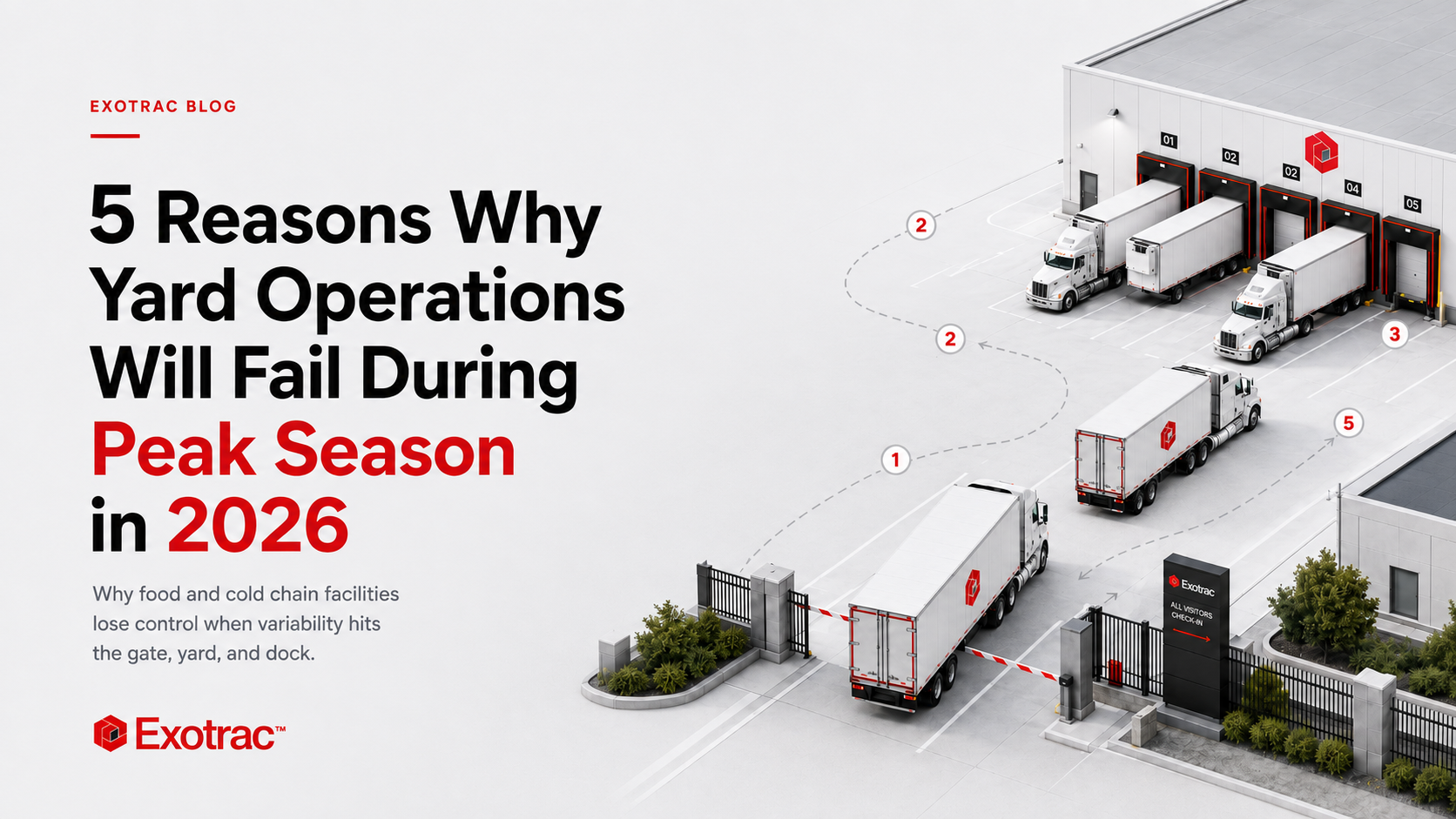
The problem is that many facilities are still managing the yard with operating models that were never designed for today’s level of volatility.
Anyone who has spent time inside a food manufacturing facility during peak season has seen the same pattern play out.
Trailers start arriving faster than docks can absorb them. Refrigerated equipment begins stacking up across the yard. Drivers wait for assignments that keep changing. Warehouse supervisors start reprioritizing inbound product almost hour by hour. Transportation teams scramble to adjust schedules while operations managers try to keep product moving without disrupting throughput across the facility.
At some point, the yard becomes congested enough that everyone starts to feel it.
Warehouse productivity slows down. Driver dwell increases. Detention costs rise. Product flow becomes inconsistent. Teams shift into reactive mode.
Then the conversations start.
Transportation blames warehousing. Warehousing blames labor. Operations blames execution. And eventually, somebody blames the yard.
But in most cases, the yard was never really the problem.
Peak season simply exposes the operational gaps that were already there.
In food and cold chain logistics, the yard has quietly become one of the most important operational control points in the supply chain. It sits directly between transportation and warehousing, which means every delay, schedule change, labor shortage, dock disruption, or inbound surge eventually shows up there first.
The problem is that many facilities are still managing the yard with operating models that were never designed for today’s level of volatility.
Here’s five reasons why yard operations tend to fail during peak seasons.
- The yard is still being managed like a support function
- Too much of the operation still depends on human coordination
- Transportation, warehousing, and yard operations are still too disconnected
- Visibility alone is not fixing the problem
- Most facilities were never designed to absorb this much variability
- standardizing operational workflows across the facility
- improving real-time visibility into trailer movement and dock activity
- reducing dependency on manual coordination
- connecting transportation, warehouse, and yard execution
- improving predictive planning capabilities
- creating more consistent operational decision-making